
Introduction

Whether you’re building your first application, scaling a growing product, or updating existing systems, architectural choice is one of the most important parts.

The discussion often comes down to two options: monolithic architecture or microservices. Both approaches are used and have advantages. But, despite this, both can become a problem if they don’t fit your project’s needs. 

Even a big company like Netflix faced this challenge in 2008. Due to the number of users increasing, it had to come to a microservices migration. The process involved breaking its monolithic architecture into a number of independent, cloud-hosted services on AWS to achieve scalability.

In this article, we review both approaches: monolithic and microservice architecture to make those decisions easier. We discuss their core differences, advantages, and disadvantages. 

In the second part of the article, we’ll share with you our real-life experience using the story of one of our clients as an example. 

Let’s start by looking at both approaches and how to choose between them.

What Is Monolithic Architecture?

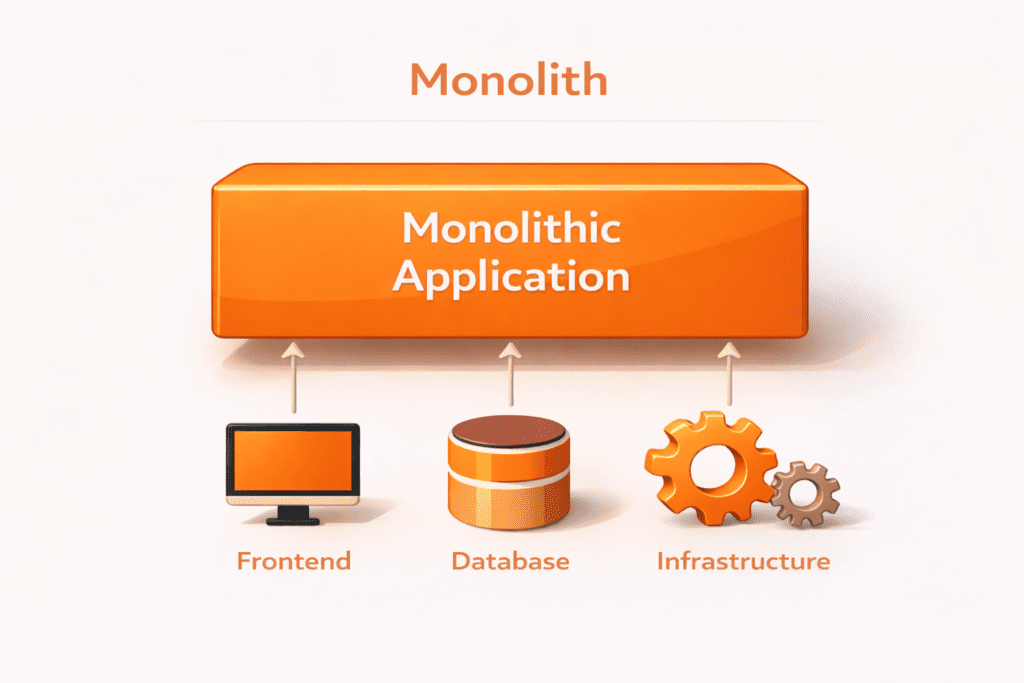
A monolithic architecture is a traditional model of a software program, which is built as a single unit that is self-contained and independent from other applications. A classic way to imagine this model is as a big box, with everything from the user interface to the database logic packed into one place.

Monolithic architecture typically involves:

– A single codebase: all functionality lives in one unified project or repository.

– Tightly coupled components: changes in one part of the system often affect others.

– Unified deployment: the entire application is compiled, built, and deployed as a whole, even for minor updates.

– Shared resources: components commonly share memory, data models, and infrastructure.

Monoliths can be convenient early on in a project’s life for ease of code management, cognitive overhead, and deployment. This allows everything in the monolith to be released at once.
Advantages of a monolithic architecture

Monolithic architecture has been around for many years.

It’s time-tested and well-known for its simplicity, ease of development, based on one code base. Let’s review what advantages a monolithic architecture includes: 

Easy deployment: when the whole app ships as one package, deployment gets easier to manage.

Development: with a single codebase, developers can build faster and avoid the overhead that comes with splitting everything into services. It’s often just the right fit for small or mid-sized projects.

Simplified testing: since a monolithic application is a single, centralized unit, end-to-end testing can be performed faster than with a distributed application. 

Easy debugging: as all code is located in one place, it’s easier to spot and fix issues without having to track them across multiple services.

Disadvantages of a monolithic architecture

Sometimes monoliths hit growing pains. It could be the signal that it’s time to rethink the architecture and explore alternatives. As with the case of Netflix, monolithic applications can be quite effective until they grow too large and scaling becomes a challenge. 

Let’s move on to discussing disadvantages of some more monolith architecture: 

The speed of development can decrease: As the project grows, the codebase can become harder to navigate. Refactoring may feel risky, and small fixes can mean rebuilding and redeploying the entire app.

Scalability: you can’t scale individual components.

Reliability: if there’s an error in any module, it could affect the entire application’s availability.

Difficult to adopt technology: any changes in the framework or language affect the entire application, making changes often expensive and time-consuming.

Deployment: A small change to a monolithic application requires redeployment.

What is microservice architecture?

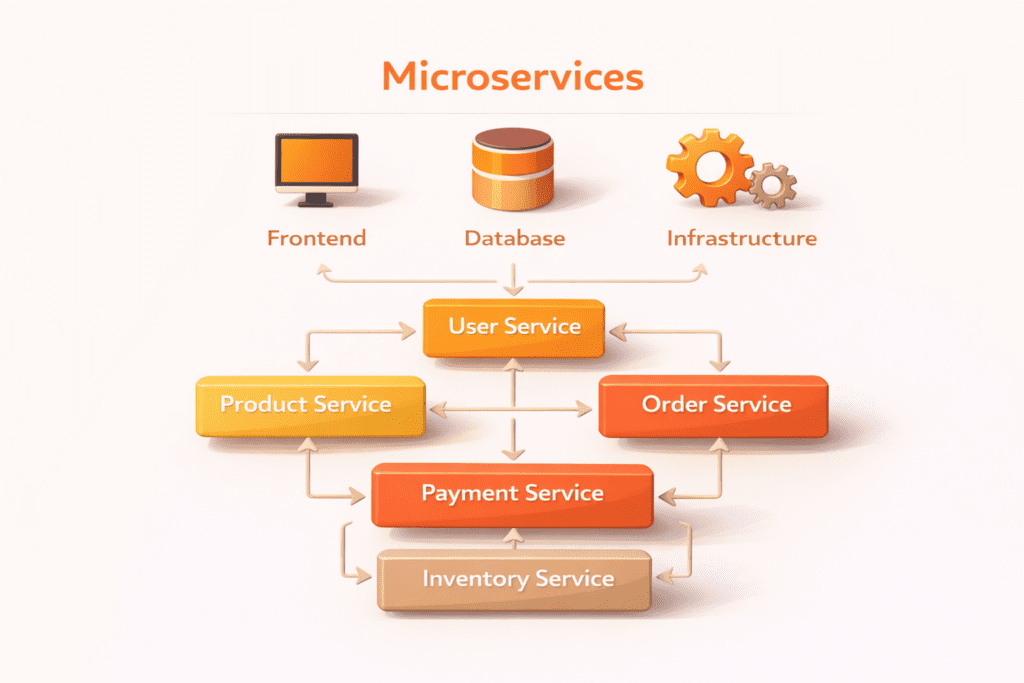
A microservices architecture, also known as microservices, is an architectural method that relies on a series of independently deployable services. Rather than a single, unified unit, a microservices architecture consists of a collection of smaller, independently deployable services.

Microservices divide a major business into independent code bases. Updating, testing, deployment, and scaling are implemented within each service. Microservices don’t reduce complexity, but they make any complexity more manageable by separating tasks into smaller processes that function independently of each other and contribute to the overall whole. 

It’s worth noting that microservices follow a more modern approach — and they’ve gained significant traction in recent years. Their compatibility with DevOps, automation, and CI/CD pipelines makes fast, reliable releases much easier to achieve.
Advantages of a microservice architecture

Microservices aren’t a universal solution for all types of projects, but they solve a number of problems for growing software and companies. In short, the advantages of microservices are: 

Flexible scaling: if a microservice reaches its load capacity, new instances of that service can rapidly be deployed to help relieve pressure. 

Highly maintainable and testable: Since a microservices architecture consists of units that run independently, each service can be developed, updated, and scaled without affecting the other services. Software fixes and updates can be performed more frequently, with improved reliability and performance.  

Independently deployable: Since microservices are individual units, they allow fast and easy independent deployment of individual features.  

High reliability: You can deploy changes for a specific service without the threat of bringing down the application.

Disadvantages of a microservice architecture

Despite a ton of advantages, microservices have some disadvantages too. Below you can find a detailed list of them: 

Complexity of development: Microservices can make the development process more difficult. It can be challenging to determine how different components relate to each other, who owns a particular software component, or how to avoid interfering with dependent components. 

Development sprawl: If development sprawl isn’t properly managed, it results in slower development speed and poor operational performance. 

Infrastructure costs: Each new microservice can have its own cost for test suite, deployment playbooks, hosting infrastructure, monitoring tools, and more.

Debugging challenges: Each microservice has its own set of logs, which makes debugging more complicated. Plus, a single business process can run across multiple machines, further complicating debugging. 

Our experience using a real client as an example

Our team has recently worked on a multi-tenancy project where we faced a discussion about which kind of architecture would be better for the platform. The project was created to improve and simplify the testing processes for businesses and individuals. The platform is planned to be scaled in the future, and we achieve that the number of users will increase. 

That is why we started to consider both options and weigh all pros and cons. The initial project assessment assumed a single-database architecture. As we approached the multi-tenancy architecture development stage, we conducted a more in-depth analysis and concluded that separating the databases would be a more suitable option. This approach offers us several advantages, two of which are particularly important:

  1. A higher level of platform security and an additional layer of protection. In the event of a data leak, if the databases are separated, we will only lose data from one specific workspace. The remaining databases will remain secure.
  2. The ability to work with large volumes of data without increasing processing time or server load. This architecture is faster and can handle higher loads.

However, this approach will require more work hours, as it involves numerous additional tasks. We conducted a series of calculations and determined that in such a way, approximately 1,500–2,000 online users could use the system, and 100, 000 registered. It would fully cover all needs and function correctly. Therefore, we settled on considering a monolithic architecture, which we tried to adapt to the project. 

If the number of users grows in the future, we will still need to redesign this part of the system and transition to microservices at some point as the load increases. The client approved this approach, as for now, he has a clear deadline for completing the project.

Important Note: on an already launched and actively used platform, this would be significantly more difficult. It would require two to three times more time than the current stage. Therefore, the project’s monolithic architecture is currently being developed in such a way that the future transition to microservices is as simple as possible.

Summary
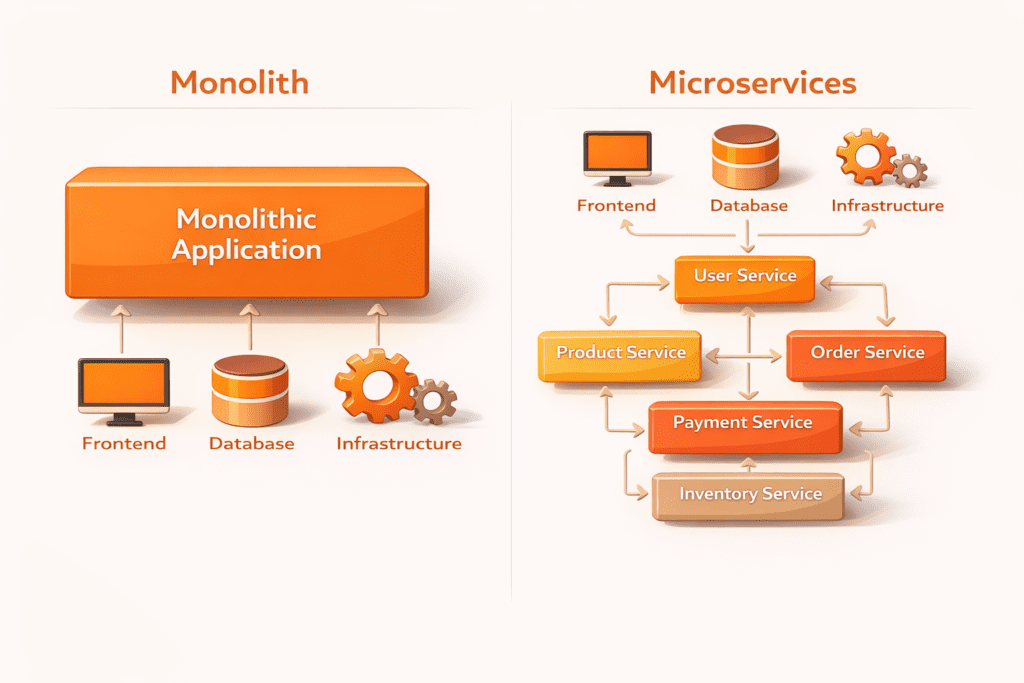
Choosing between monolith and microservices is not about following the most modern approach – it’s about aligning architecture with business goals and technical reality.

Monoliths offer simplicity, speed, and cost efficiency. Microservices provide flexibility, scalability, and resilience for complex systems. Understanding your project’s needs, constraints, and growth plans always helps you to make the right decision.

If you’re unsure which architecture fits your project, you can always contact us, so we can help you choose the right solution for your product.


Monolith vs Microservices architecture: what is best for your project?

Introduction

Whether you’re building your first application, scaling a growing product, or updating existing systems, architectural choice is one of the most important parts.

The discussion often comes down to two options: monolithic architecture or microservices. Both approaches are used and have advantages. But, despite this, both can become a problem if they don’t fit your project’s needs. 

Even a big company like Netflix faced this challenge in 2008. Due to the number of users increasing, it had to come to a microservices migration. The process involved breaking its monolithic architecture into a number of independent, cloud-hosted services on AWS to achieve scalability.

In this article, we review both approaches: monolithic and microservice architecture to make those decisions easier. We discuss their core differences, advantages, and disadvantages. 

In the second part of the article, we’ll share with you our real-life experience using the story of one of our clients as an example. 

Let’s start by looking at both approaches and how to choose between them.

What Is Monolithic Architecture?

A monolithic architecture is a traditional model of a software program, which is built as a single unit that is self-contained and independent from other applications. A classic way to imagine this model is as a big box, with everything from the user interface to the database logic packed into one place.

Monolithic architecture typically involves:

– A single codebase: all functionality lives in one unified project or repository.

– Tightly coupled components: changes in one part of the system often affect others.

– Unified deployment: the entire application is compiled, built, and deployed as a whole, even for minor updates.

– Shared resources: components commonly share memory, data models, and infrastructure.

Monoliths can be convenient early on in a project’s life for ease of code management, cognitive overhead, and deployment. This allows everything in the monolith to be released at once.

Advantages of a monolithic architecture

Monolithic architecture has been around for many years.

It’s time-tested and well-known for its simplicity, ease of development, based on one code base. Let’s review what advantages a monolithic architecture includes: 

Easy deployment: when the whole app ships as one package, deployment gets easier to manage.

Development: with a single codebase, developers can build faster and avoid the overhead that comes with splitting everything into services. It’s often just the right fit for small or mid-sized projects.

Simplified testing: since a monolithic application is a single, centralized unit, end-to-end testing can be performed faster than with a distributed application. 

Easy debugging: as all code is located in one place, it’s easier to spot and fix issues without having to track them across multiple services.

Disadvantages of a monolithic architecture

Sometimes monoliths hit growing pains. It could be the signal that it’s time to rethink the architecture and explore alternatives. As with the case of Netflix, monolithic applications can be quite effective until they grow too large and scaling becomes a challenge. 

Let’s move on to discussing disadvantages of some more monolith architecture: 

The speed of development can decrease: As the project grows, the codebase can become harder to navigate. Refactoring may feel risky, and small fixes can mean rebuilding and redeploying the entire app.

Scalability: you can’t scale individual components.

Reliability: if there’s an error in any module, it could affect the entire application’s availability.

Difficult to adopt technology: any changes in the framework or language affect the entire application, making changes often expensive and time-consuming.

Deployment: A small change to a monolithic application requires redeployment.

What is microservice architecture?

A microservices architecture, also known as microservices, is an architectural method that relies on a series of independently deployable services. Rather than a single, unified unit, a microservices architecture consists of a collection of smaller, independently deployable services.

Microservices divide a major business into independent code bases. Updating, testing, deployment, and scaling are implemented within each service. Microservices don’t reduce complexity, but they make any complexity more manageable by separating tasks into smaller processes that function independently of each other and contribute to the overall whole. 

It’s worth noting that microservices follow a more modern approach — and they’ve gained significant traction in recent years. Their compatibility with DevOps, automation, and CI/CD pipelines makes fast, reliable releases much easier to achieve.

Advantages of a microservice architecture

Microservices aren’t a universal solution for all types of projects, but they solve a number of problems for growing software and companies. In short, the advantages of microservices are: 

Flexible scaling: if a microservice reaches its load capacity, new instances of that service can rapidly be deployed to help relieve pressure. 

Highly maintainable and testable: Since a microservices architecture consists of units that run independently, each service can be developed, updated, and scaled without affecting the other services. Software fixes and updates can be performed more frequently, with improved reliability and performance.  

Independently deployable: Since microservices are individual units, they allow fast and easy independent deployment of individual features.  

High reliability: You can deploy changes for a specific service without the threat of bringing down the application.

Disadvantages of a microservice architecture

Despite a ton of advantages, microservices have some disadvantages too. Below you can find a detailed list of them: 

Complexity of development: Microservices can make the development process more difficult. It can be challenging to determine how different components relate to each other, who owns a particular software component, or how to avoid interfering with dependent components. 

Development sprawl: If development sprawl isn’t properly managed, it results in slower development speed and poor operational performance. 

Infrastructure costs: Each new microservice can have its own cost for test suite, deployment playbooks, hosting infrastructure, monitoring tools, and more.

Debugging challenges: Each microservice has its own set of logs, which makes debugging more complicated. Plus, a single business process can run across multiple machines, further complicating debugging. 

Our experience using a real client as an example

Our team has recently worked on a multi-tenancy project where we faced a discussion about which kind of architecture would be better for the platform. The project was created to improve and simplify the testing processes for businesses and individuals. The platform is planned to be scaled in the future, and we achieve that the number of users will increase. 

That is why we started to consider both options and weigh all pros and cons. The initial project assessment assumed a single-database architecture. As we approached the multi-tenancy architecture development stage, we conducted a more in-depth analysis and concluded that separating the databases would be a more suitable option. This approach offers us several advantages, two of which are particularly important:

  1. A higher level of platform security and an additional layer of protection. In the event of a data leak, if the databases are separated, we will only lose data from one specific workspace. The remaining databases will remain secure.
  2. The ability to work with large volumes of data without increasing processing time or server load. This architecture is faster and can handle higher loads.

However, this approach will require more work hours, as it involves numerous additional tasks. We conducted a series of calculations and determined that in such a way, approximately 1,500–2,000 online users could use the system, and 100, 000 registered. It would fully cover all needs and function correctly. Therefore, we settled on considering a monolithic architecture, which we tried to adapt to the project. 

If the number of users grows in the future, we will still need to redesign this part of the system and transition to microservices at some point as the load increases. The client approved this approach, as for now, he has a clear deadline for completing the project.

Important Note: on an already launched and actively used platform, this would be significantly more difficult. It would require two to three times more time than the current stage. Therefore, the project’s monolithic architecture is currently being developed in such a way that the future transition to microservices is as simple as possible.

Summary

Choosing between monolith and microservices is not about following the most modern approach – it’s about aligning architecture with business goals and technical reality.

Monoliths offer simplicity, speed, and cost efficiency. Microservices provide flexibility, scalability, and resilience for complex systems. Understanding your project’s needs, constraints, and growth plans always helps you to make the right decision.

If you’re unsure which architecture fits your project, you can always contact us, so we can help you choose the right solution for your product.

Introduction

Whether you’re building your first application, scaling a growing product, or updating existing systems, architectural choice is one of the most important parts.

The discussion often comes down to two options: monolithic architecture or microservices. Both approaches are used and have advantages. But, despite this, both can become a problem if they don’t fit your project’s needs. 

Even a big company like Netflix faced this challenge in 2008. Due to the number of users increasing, it had to come to a microservices migration. The process involved breaking its monolithic architecture into a number of independent, cloud-hosted services on AWS to achieve scalability.

In this article, we review both approaches: monolithic and microservice architecture to make those decisions easier. We discuss their core differences, advantages, and disadvantages. 

In the second part of the article, we’ll share with you our real-life experience using the story of one of our clients as an example. 

Let’s start by looking at both approaches and how to choose between them.

What Is Monolithic Architecture?

A monolithic architecture is a traditional model of a software program, which is built as a single unit that is self-contained and independent from other applications. A classic way to imagine this model is as a big box, with everything from the user interface to the database logic packed into one place.

Monolithic architecture typically involves:

– A single codebase: all functionality lives in one unified project or repository.

– Tightly coupled components: changes in one part of the system often affect others.

– Unified deployment: the entire application is compiled, built, and deployed as a whole, even for minor updates.

– Shared resources: components commonly share memory, data models, and infrastructure.

Monoliths can be convenient early on in a project’s life for ease of code management, cognitive overhead, and deployment. This allows everything in the monolith to be released at once.

Advantages of a monolithic architecture

Monolithic architecture has been around for many years.

It’s time-tested and well-known for its simplicity, ease of development, based on one code base. Let’s review what advantages a monolithic architecture includes: 

Easy deployment: when the whole app ships as one package, deployment gets easier to manage.

Development: with a single codebase, developers can build faster and avoid the overhead that comes with splitting everything into services. It’s often just the right fit for small or mid-sized projects.

Simplified testing: since a monolithic application is a single, centralized unit, end-to-end testing can be performed faster than with a distributed application. 

Easy debugging: as all code is located in one place, it’s easier to spot and fix issues without having to track them across multiple services.

Disadvantages of a monolithic architecture

Sometimes monoliths hit growing pains. It could be the signal that it’s time to rethink the architecture and explore alternatives. As with the case of Netflix, monolithic applications can be quite effective until they grow too large and scaling becomes a challenge. 

Let’s move on to discussing disadvantages of some more monolith architecture: 

The speed of development can decrease: As the project grows, the codebase can become harder to navigate. Refactoring may feel risky, and small fixes can mean rebuilding and redeploying the entire app.

Scalability: you can’t scale individual components.

Reliability: if there’s an error in any module, it could affect the entire application’s availability.

Difficult to adopt technology: any changes in the framework or language affect the entire application, making changes often expensive and time-consuming.

Deployment: A small change to a monolithic application requires redeployment.

What is microservice architecture?

A microservices architecture, also known as microservices, is an architectural method that relies on a series of independently deployable services. Rather than a single, unified unit, a microservices architecture consists of a collection of smaller, independently deployable services.

Microservices divide a major business into independent code bases. Updating, testing, deployment, and scaling are implemented within each service. Microservices don’t reduce complexity, but they make any complexity more manageable by separating tasks into smaller processes that function independently of each other and contribute to the overall whole. 

It’s worth noting that microservices follow a more modern approach — and they’ve gained significant traction in recent years. Their compatibility with DevOps, automation, and CI/CD pipelines makes fast, reliable releases much easier to achieve.

Advantages of a microservice architecture

Microservices aren’t a universal solution for all types of projects, but they solve a number of problems for growing software and companies. In short, the advantages of microservices are: 

Flexible scaling: if a microservice reaches its load capacity, new instances of that service can rapidly be deployed to help relieve pressure. 

Highly maintainable and testable: Since a microservices architecture consists of units that run independently, each service can be developed, updated, and scaled without affecting the other services. Software fixes and updates can be performed more frequently, with improved reliability and performance.  

Independently deployable: Since microservices are individual units, they allow fast and easy independent deployment of individual features.  

High reliability: You can deploy changes for a specific service without the threat of bringing down the application.

Disadvantages of a microservice architecture

Despite a ton of advantages, microservices have some disadvantages too. Below you can find a detailed list of them: 

Complexity of development: Microservices can make the development process more difficult. It can be challenging to determine how different components relate to each other, who owns a particular software component, or how to avoid interfering with dependent components. 

Development sprawl: If development sprawl isn’t properly managed, it results in slower development speed and poor operational performance. 

Infrastructure costs: Each new microservice can have its own cost for test suite, deployment playbooks, hosting infrastructure, monitoring tools, and more.

Debugging challenges: Each microservice has its own set of logs, which makes debugging more complicated. Plus, a single business process can run across multiple machines, further complicating debugging. 

Our experience using a real client as an example

Our team has recently worked on a multi-tenancy project where we faced a discussion about which kind of architecture would be better for the platform. The project was created to improve and simplify the testing processes for businesses and individuals. The platform is planned to be scaled in the future, and we achieve that the number of users will increase. 

That is why we started to consider both options and weigh all pros and cons. The initial project assessment assumed a single-database architecture. As we approached the multi-tenancy architecture development stage, we conducted a more in-depth analysis and concluded that separating the databases would be a more suitable option. This approach offers us several advantages, two of which are particularly important:

  1. A higher level of platform security and an additional layer of protection. In the event of a data leak, if the databases are separated, we will only lose data from one specific workspace. The remaining databases will remain secure.
  2. The ability to work with large volumes of data without increasing processing time or server load. This architecture is faster and can handle higher loads.

However, this approach will require more work hours, as it involves numerous additional tasks. We conducted a series of calculations and determined that in such a way, approximately 1,500–2,000 online users could use the system, and 100, 000 registered. It would fully cover all needs and function correctly. Therefore, we settled on considering a monolithic architecture, which we tried to adapt to the project. 

If the number of users grows in the future, we will still need to redesign this part of the system and transition to microservices at some point as the load increases. The client approved this approach, as for now, he has a clear deadline for completing the project.

Important Note: on an already launched and actively used platform, this would be significantly more difficult. It would require two to three times more time than the current stage. Therefore, the project’s monolithic architecture is currently being developed in such a way that the future transition to microservices is as simple as possible.

Summary

Choosing between monolith and microservices is not about following the most modern approach – it’s about aligning architecture with business goals and technical reality.

Monoliths offer simplicity, speed, and cost efficiency. Microservices provide flexibility, scalability, and resilience for complex systems. Understanding your project’s needs, constraints, and growth plans always helps you to make the right decision.

If you’re unsure which architecture fits your project, you can always contact us, so we can help you choose the right solution for your product.